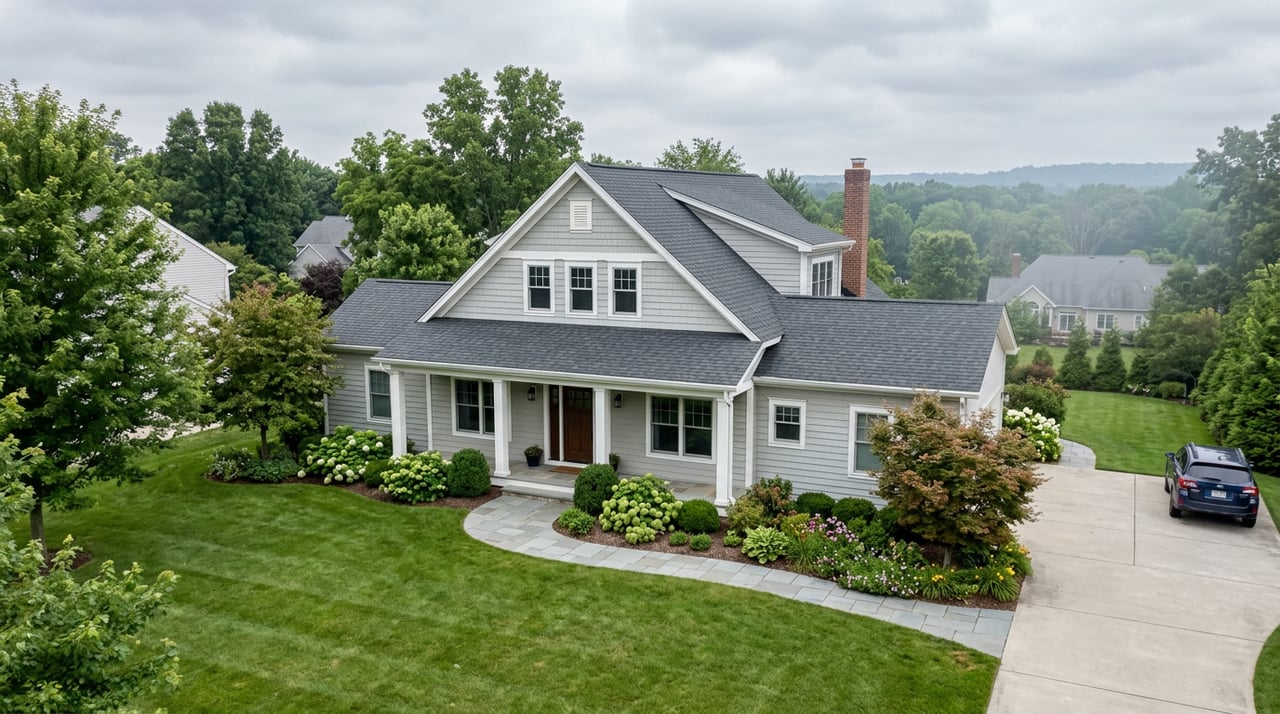
Lanai Is Building More Housing Than Ever. The For-Sale Market Barely Moves.
September 24, 2026
September 24, 2026
Drive through Lānaʻi City this year and you will pass at least three active construction sites. A rent-to-own subdivision is breaking ground near Fifth Street. A workforce housing project at Ninth and Queen is finishing up. Pūlama Lānaʻi, the company that manages Larry Ellison's holdings on the island, has just filed to rezone 170 acres near Sensei Lānaʻi for new villas and spa space. By any visual measure, Lānaʻi is building.
None of that shows up where a buyer would expect it to. As of early September 2026, active listings on the island sat in the low teens, a number that has barely budged in years. If you are comparing Lānaʻi to another Maui County submarket using the median price you saw on a portal, you are comparing against a number built on two or three closed sales a month. The mechanism behind that gap, not the price itself, is what actually matters if you are serious about buying here.
Every writeup of Lānaʻi leads with the same fact: Larry Ellison owns 98 percent of the island, a stake he bought from Castle & Cooke in 2012 for roughly $300 million. It is true, and it is also the wrong number to fixate on if you are trying to understand the housing market specifically.
The more useful figure came out of Building Industry Hawaii's 2024 coverage of the Hōkūao housing project, which noted that Pūlama Lānaʻi owns only about 30 percent of the island's residential properties outright, despite controlling nearly all of the land beneath them. That gap between land ownership and home ownership is the whole story. Most existing houses on Lānaʻi already sit in private hands, which is why a resale market exists at all. But the growth in housing supply, the hundreds of new units going up right now, is being built and held by Pūlama itself, structured in ways that keep it out of the resale pipeline entirely.
Look at Lānaʻi's numbers from four angles taken within the same several-month window in 2026 and you get four different markets:
| Source and window | What it reported |
|---|---|
| Active listing data, May 2026 | Median list price around $770,000, down roughly 10 percent year over year; median 159 days on market |
| Closed sales, three months ending May 2026 | Median sale price $637,000, down 22.8 percent year over year, on just two recorded sales |
| Closed sales, single month of April 2026 | Median sale price $762,106, up 45.2 percent year over year |
| Active listing snapshot, September 3, 2026 | 14 listings, median list price $789,000, average 192 days on market, average price near $1,093 per square foot |
None of these figures are wrong. They are measuring a market so thin that one or two transactions can swing a year-over-year comparison by 40 or 50 points in either direction. A 22 percent decline and a 45 percent increase, reported for overlapping periods in the same year, are not a contradiction. They are what happens when "median" is calculated from a sample size you could count on one hand. Average days on market ranges just as widely, from under 100 in some reports to well over 500 in others, depending on whether the snapshot includes a handful of long-sitting luxury estates near Mānele Bay alongside modest plantation-era cottages in town.
If you are used to reading market reports from Kīhei or Wailuku, where hundreds of transactions smooth out the noise, Lānaʻi's numbers will feel unstable. They are not unstable. They are honest about how few homes actually change hands.
So if hundreds of units are under construction, where does that supply go if not onto the resale market?
Hōkūao, the island's first major housing development in more than three decades, broke ground in 2022 and finished its build-out with a mix of affordable and market-rate homes, more than half of them designated as affordable housing in perpetuity. All of it is rental. None of it was built for sale.
The next wave is structured to stay off the market even longer. Kaiāulu O Lānaʻi, which broke ground with a blessing ceremony on February 18, 2026, will deliver 72 rent-to-own units at the bottom of Fifth Street, backed by $17 million in Maui County startup funding. Maui County Councilmember Gabe Johnson, who represents Lānaʻi, explained the design choice directly to Hawaiʻi Public Radio: residents told his team during door-to-door interviews that they wanted rent-to-own specifically because they feared outside buyers with more cash would outbid them if the units went straight to market. Under the plan, residents can occupy a unit for fifteen years before the option to purchase even opens. That is new housing supply that will not touch a resale listing for over a decade, by design.
The Ninth and Queen Street Triangle Housing Development, targeted for completion around the end of 2025, follows the same rental-first pattern.
It would be easy to assume the slack gets picked up on the high end instead, since Lānaʻi's other economic engine is its two Four Seasons resorts. That pipeline is narrowing as well.
In September 2025, Pūlama Lānaʻi closed its own rock and concrete division, the unit that had built luxury vacation homes during the island's transformation from pineapple plantation to resort destination, eliminating 15 positions. The company told Honolulu Civil Beat the closure reflected a shift away from resort residential development toward local infrastructure projects.
Then in April 2026, Pūlama filed a petition with the State Land Use Commission to rezone about 170 acres near Sensei Lānaʻi, converting pastureland and part of a former golf course into an expanded resort district with new villas and spa space. Reporting from Maui Now and the Hawaiʻi Journalism Initiative in May 2026 covered the filing, and it lines up with what Pūlama Lānaʻi President Kurt Matsumoto had already told Aloha State Daily the year before: the company was not developing luxury homes for sale, and the priority was guest amenities and keeping island employment steady rather than adding resale inventory.
Put the two halves together and the picture is consistent. The workforce and affordable pipeline is rental and rent-to-own. The resort pipeline is guest villas, not homes for sale. Neither adds to the small pool of privately owned houses that actually trade hands on Lānaʻi.
If you are weighing Lānaʻi against Kīhei, Wailuku, or Pukalani on median price alone, you are measuring the wrong thing. Lānaʻi's median is not a signal of affordability or appreciation the way it is elsewhere in Maui County. It is a reflection of which one or two homes happened to close that month.
What you can rely on: the pool of privately held homes on Lānaʻi is finite and will not be meaningfully replenished by the construction you see underway. New units are entering the housing stock, but they are entering it as rentals and rent-to-own contracts that keep local demand for existing rentals lower, not as competition for the resale listings you would actually be bidding on. If anything, that could tighten competition for the private homes that do come up for sale, since fewer island residents will be shopping the open market for a place to live.
Expect long timelines. Whether the figure you trust is 84 days or 541, every source agrees Lānaʻi sells slower than the rest of Maui County, where typical days on market runs closer to 35 to 55 days. Financing, inspections, and title work on Lānaʻi can also take longer simply because there are fewer local closings for lenders, inspectors, and title companies to move through routinely.
Why do median price reports for Lānaʻi swing so much from source to source? Because the sample size is tiny. When a market closes two or three homes in a typical month, one high-end sale or one distressed sale can move the year-over-year percentage by 20 or 40 points without reflecting any real shift in value.
Will any of the new Pūlama-built housing eventually reach the resale market? Some of it might, decades from now. Rent-to-own units at Kaiāulu O Lānaʻi carry a purchase option starting in year sixteen. Hōkūao's units are designated rental in perpetuity for the affordable portion. None of it is structured to add near-term resale inventory.
Is the low number of listings itself unusual for an island this size? Given that private homeowners hold roughly 30 percent of residential properties and the rest sits under one company's long-term stewardship, a thin resale market is the expected outcome, not an anomaly.
Lānaʻi rewards patience and local guidance more than most Maui County submarkets. If you are weighing a purchase here, or trying to understand how it fits alongside the rest of the islands we cover, Emerald Club Realty can walk you through what is actually available, what is coming, and what those numbers really mean for your timeline. Work with our Maui Ohana.
The possibilities in Maui real estate are boundless, whether you are looking to settle permanently in a Maui home or perhaps part time in a condo that you can rent out for the rest of the year. If you want to build, you will find a myriad of beautiful vacant land listings to choose from.