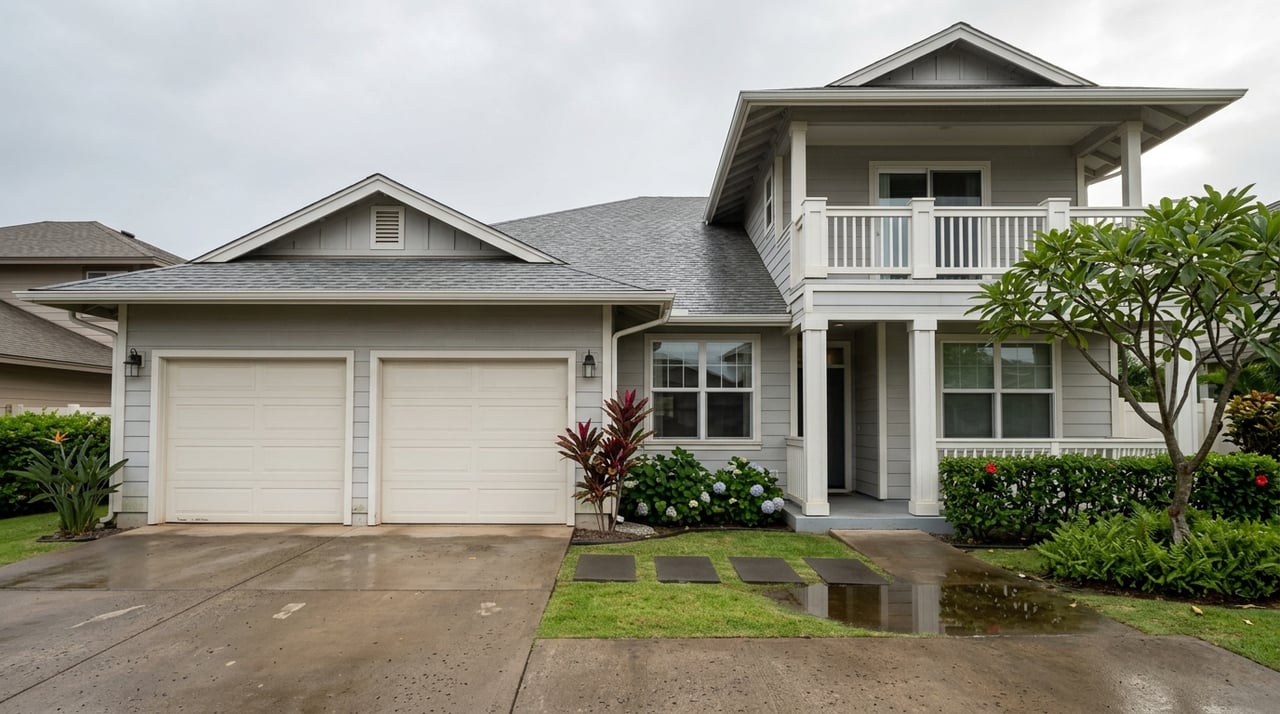
Pukalani and Makawao Home Buying Guide for Upcountry
July 9, 2026
July 9, 2026
Wondering whether Pukalani or Makawao is the better fit for your Upcountry Maui home search? You are not alone. These neighboring communities can look similar at first, but the day-to-day feel, lot patterns, and property due diligence details can shape your experience in very different ways. This guide will help you compare both areas, understand what to watch for in older Upcountry homes, and shop with more confidence. Let’s dive in.
If coastal Maui feels too warm, too busy, or too limited in detached-home options, Upcountry often moves to the top of your list. Pukalani and Makawao sit on the northwest upland slopes of Haleakalā, in a region known for rolling ridge tops, deep gulches, and a climate that changes with elevation and exposure.
Most developed and agricultural land in the broader area falls between about 1,500 and 3,500 feet in elevation. Rainfall is often strongest around the 3,000-foot band, and much of the region averages roughly 30 to 60 inches of annual rainfall. For you as a buyer, that means one simple thing: Upcountry living can feel more variable than life in many coastal Maui communities.
Pukalani and Makawao are close together, but they do not feel exactly the same. Local climate guides place Pukalani at about 1,526 feet and Makawao at about 1,600 feet, which helps explain why Pukalani is often a touch warmer while Makawao can feel slightly cooler.
County and state descriptions also point to a lifestyle difference between the two. Pukalani is primarily a residential community, while Makawao is known as a country-town business district with a historic, paniolo, and arts identity. If you want a simple way to compare them, think of Pukalani as more residential and routine-friendly, while Makawao offers more town character and a stronger main street feel.
Both communities are strongly single-family markets. In Pukalani, there are 3,027 housing units, with 61% owner occupancy and 93% single-unit structures. In Makawao, there are 2,833 housing units, with 67% owner occupancy and 93% single-unit structures.
That matters because it tells you these are established, owner-occupant-heavy communities where detached homes are the norm. If you are searching for a condo-driven environment, this part of Upcountry may not match your priorities as closely as other Maui submarkets.
Median value estimates also show how established these markets are. Pukalani is estimated at $973,700, while Makawao is estimated at $888,000. Those numbers do not price any specific property, but they do support the idea that both communities are mature, desirable home markets with strong owner presence.
One of the biggest mistakes buyers make is assuming all Upcountry properties come with large acreage. In reality, lot size depends heavily on the specific pocket you are shopping.
Many village and subdivision lots in Pukalani and Makawao cluster around roughly 7,400 to 7,700 square feet, or about 0.17 to 0.18 acres. You will also see many homes on parcels closer to 0.23 to 0.25 acres. At the same time, hillside and more rural areas, including roads such as Piʻiholo and Olinda, can range from about 1 acre to more than 10 acres.
That range is important when you compare listings. “Upcountry lot size” is not one thing. You may find a manageable suburban-style parcel in one area and estate-scale land in another, even within the same general search map.
A large share of the housing stock in both communities was built decades ago. Listing examples in Pukalani include homes from 1976, 1978, 1980, and 1986. Makawao examples include homes from 1975, 1976, 1980, 1982, and 1983, along with some newer-construction pockets.
For you, that does not automatically mean a problem. It does mean you should expect more variation in condition, maintenance history, updates, and major systems. Two homes with similar square footage can feel very different depending on renovations, care over time, and site conditions.
Utility due diligence matters in Upcountry, especially for buyers coming from the mainland. Maui County identifies the Upcountry Water System as serving Kula, Makawao, Pukalani, Haliimaile, the Maunaolu College area, and Haiku. The county also identifies Kamole Weir as serving Makawao, Pukalani, Haliimaile, and Haiku.
Maui County lifted the most recent Stage 1 Upcountry water shortage on March 16, 2026. At the same time, Water Conservation Ordinance 5929 took effect on March 1, 2026, and includes irrigation restrictions that apply even when no shortage has been declared.
That means you should not treat water as a background detail. During your search, it is smart to ask not just whether a property is on county water, but also how the home functions during dry periods and how landscaping is managed under current county rules.
Another major Upcountry detail is wastewater service. County materials state that most of the Makawao-Pukalani-Kula area is not served by county wastewater facilities. Only Haliimaile has county collection, while a portion of Pukalani uses private wastewater treatment and the remainder relies on cesspools or septic tanks.
This is one of the most important due diligence points in your search. You should not assume that county water means county sewer. Before you get too attached to a home, confirm exactly what type of wastewater system serves the property and when it was last inspected or serviced.
The broader Upcountry region generally does not have major drainage or flooding problems, but that does not mean every lot performs the same in heavy rain. County assessment documents note that Makawao has experienced sheet-flow runoff from the highlands, with minor yard and lawn inundation in some areas.
For buyers, that turns drainage from a small detail into a practical checklist item. During a showing, pay attention to lot grading, retaining walls, gutter systems, downspout discharge, and signs that water may collect or move across the property during storms.
If you are deciding between Pukalani and Makawao based on drive time alone, the numbers are fairly close. Census data shows that 76% of workers in both Pukalani and Makawao drove alone to work. Mean travel time to work was 29.7 minutes in Pukalani and 27.9 minutes in Makawao.
Maui County also identifies Haleakalā Highway and Pukalani By-Pass as major state highways, and island commuter routes connect Upcountry with other areas. In practical terms, commute differences between the two towns are real but modest. For many buyers, lifestyle fit, lot size, and property condition end up mattering more than a small drive-time gap.
If you are torn between the two, try focusing on how you want your daily life to feel. Pukalani often makes sense if you want a more residential, service-oriented base with detached homes and straightforward routines.
Makawao may be the stronger match if you want a town-centered setting with more historic character and a visible arts and paniolo identity. Neither choice is universally better. The right fit depends on whether you value a quieter residential rhythm or a stronger sense of town character.
Before writing an offer, make sure you have answers to the questions that matter most in Pukalani and Makawao.
Buying Upcountry is not just about finding the right view or floor plan. It is about matching your lifestyle to the right part of the mountain and understanding how the property works in real day-to-day conditions.
When you want practical guidance from a local team that understands Maui’s neighborhoods, property details, and ownership needs, Emerald Club Realty is here to help you move forward with confidence.
The possibilities in Maui real estate are boundless, whether you are looking to settle permanently in a Maui home or perhaps part time in a condo that you can rent out for the rest of the year. If you want to build, you will find a myriad of beautiful vacant land listings to choose from.